
Self-pour as a differentiator at Alright Brewing Co.
Who is Alright Brewing Co.
Founded in 2018 by Frederico Luz and Igor Martins, Alright Brewing Co. was born in Curitiba with a clear proposition: to create an “easy going” space where customers feel comfortable slowing down, trying new things, and enjoying the moment. The project brings together a bar, its own 500 m² brewery, and a 700 m² beer garden, working as a complete ecosystem of consumption and experience.
The brand concept starts from the idea of deserving a break — “brew up, chill out” — and everything in the space was designed to support that promise, from the architecture to the service model.
The origin of the project: from consumer to entrepreneur
Before becoming entrepreneurs, the partners came from the corporate world and had years of experience as customers of bars and breweries. That experience revealed recurring gaps: inefficient service, little clarity in the offering, and inconsistent experiences.
The decision to make their own beer came before the bar. It took three years of testing before the project matured and evolved into a physical space that brought together production, consumption, and customer relationships.
Planning: why the bar needed to be different
During planning, it became clear that just producing beer would not be enough to make an impact on the market. The bar would emerge as a strategic channel to:
- move part of the production,
- test styles,
- and build a direct relationship with the end consumer.
With no outside financing, the project moved forward on its own resources, facing challenges common to entrepreneurship: unreliable suppliers, delays, and constant adjustments until the operation was consolidated.
The choice of myTapp self-pour
Self-pour was not a later add-on. It was part of Alright’s conception from the start. The partners already knew the model as customers and saw it as a way to give consumers autonomy without giving up control.
The decision for myTapp came from a differentiator that goes beyond flow control: intelligence, data, and the ability to understand customer behavior in real time.
According to Frederico Luz, the system made it possible to access registration information and consumption patterns that help assess what works best in the portfolio and in the experience offered.
How the operation works in practice
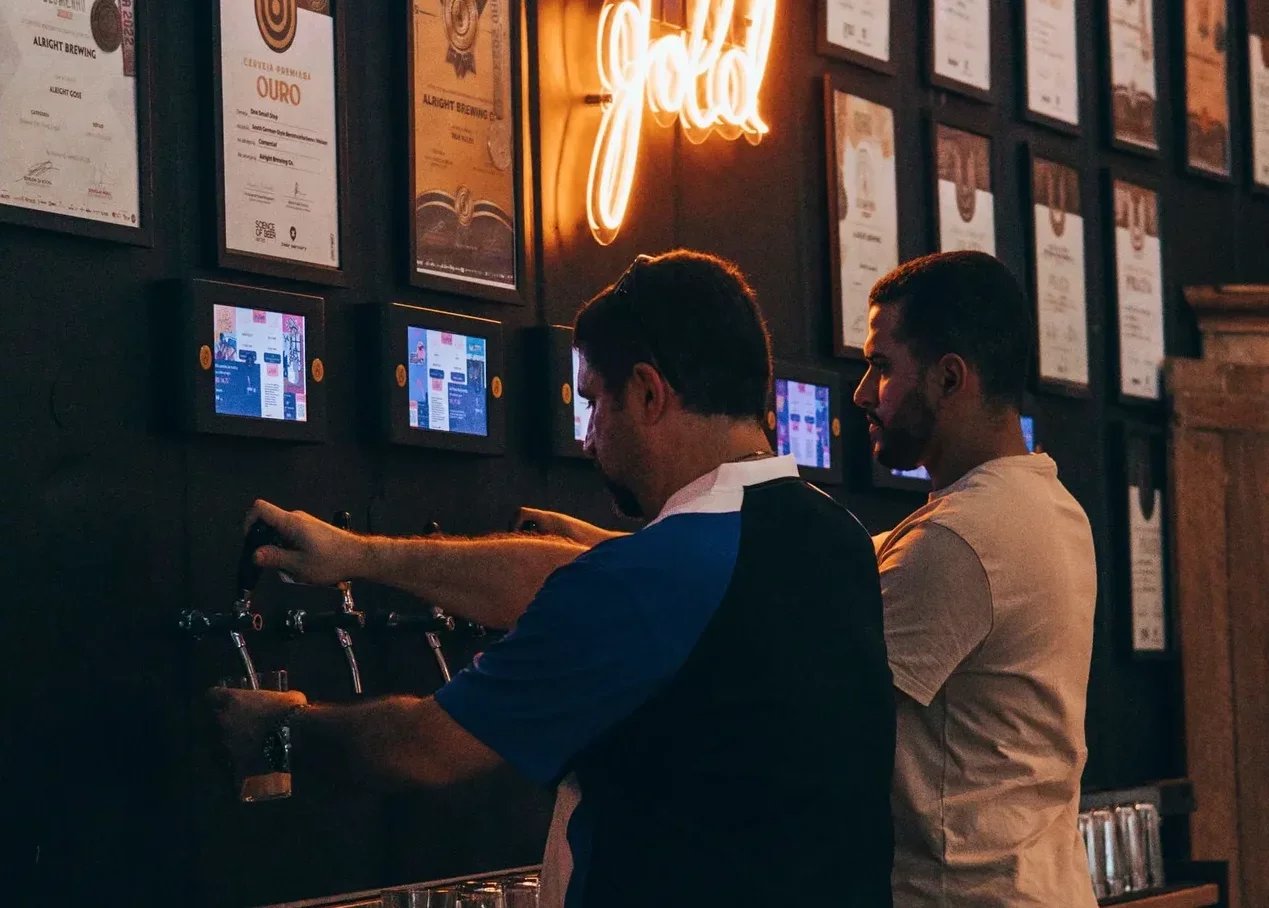
Today, Alright operates three fronts (bar, brewery, and distribution) with a lean team of nine people, serving about 500 customers per day. Self-pour keeps a constant flow even during peak periods.
The beer wall features house styles, designed for high drinkability, encouraging experimentation and repeat visits. All consumption (beers, food, and store) is centralized on the myTapp card, reducing lines and simplifying checkout.
An experience that generates engagement and organic media
The impact of the model goes beyond operations. The environment invites customers to stay, move around, and interact. The beer garden becomes an extension of the consumer’s home, with families, pets, and groups mingling naturally.
This experience is reflected in positive reviews and a constant presence in organic media, highlighting freedom of choice, prepaid-card self-pour, and the comfort of the space.
Observed results
Indicator | Impact |
|---|---|
Service | High turnover with a reduced team |
Experience | Longer stays |
Consumption | Encourages experimentation |
Payment | Fewer lines and more flow |
Brand | Strong organic presence and loyalty |
What decision-makers can learn from Alright
The Alright case shows that:
- self-pour can be a central part of brand strategy,
- customer autonomy increases satisfaction and consumption,
- operational data helps the portfolio evolve,
- a well-designed experience reduces friction without losing hospitality.
More than technology, success lies in the consistency between concept, space, and operation.
FAQ – Frequently asked questions
Does self-pour reduce the role of the staff?
No. It redirects the team’s focus to experience, support, and hospitality.
Does it only work for breweries with their own beer?
No. The model applies to bars, brewpubs, and high-traffic operations.
Do customers accept self-pour well?
Yes. According to the partners, customers like pouring for themselves when the experience is clear and smooth.
Does the system help with financial control?
Yes. Centralizing consumption makes management and data analysis easier.
Is it a scalable model?
Yes. Alright is already considering future expansion while keeping self-pour as its foundation.
Subscribe
Subscribe to the myTapp newsletter and get first access to new articles, with actionable insights for those who decide, plan, and run high-traffic businesses.
Recommended posts
Selected content to explore topics such as self-pour beer, customer experience, and operational efficiency, with practical lessons for decision-makers and those who follow market developments.
Capital Moto Week case study: how self-pour beer scaled the operation at a festival of 800,000 people
At the largest motorcycle and rock festival in Latin America, with about 800,000 people over ten days, self-pour beer kept pace with the event's growth without losing control. In the 2026 edition, the volume served rose more than 18% and the number of sales grew almost 29%, while operational efficiency went from 89% to 93%. The case shows how smart taps sustain beverage operations when the crowd arrives in waves.

Self-pour beer at parks and resorts: how to end lines and waste
In high season, the bar line is one of the biggest bottlenecks at a park or resort: visitors give up, miss out on the attractions and the operation loses sales. Self-pour beer ends the wait, cuts beverage service staff by up to 80% and reduces waste from about 15% to 3%, with real-time consumption data for management.
Self-pour draft beer for events: how to end the lines and sell more at festivals
At a festival's peak, the bar line is where revenue slips away. Self-pour draft beer ends the wait, cuts service staff by up to 80% and reduces waste from about 15% to 3%. With real-time consumption data, the operation decides on the spot and sells more at the moment that matters most.

Receive regular updates on new products and industry trends.