
Self-pour beer at parks and resorts: how to end lines and waste
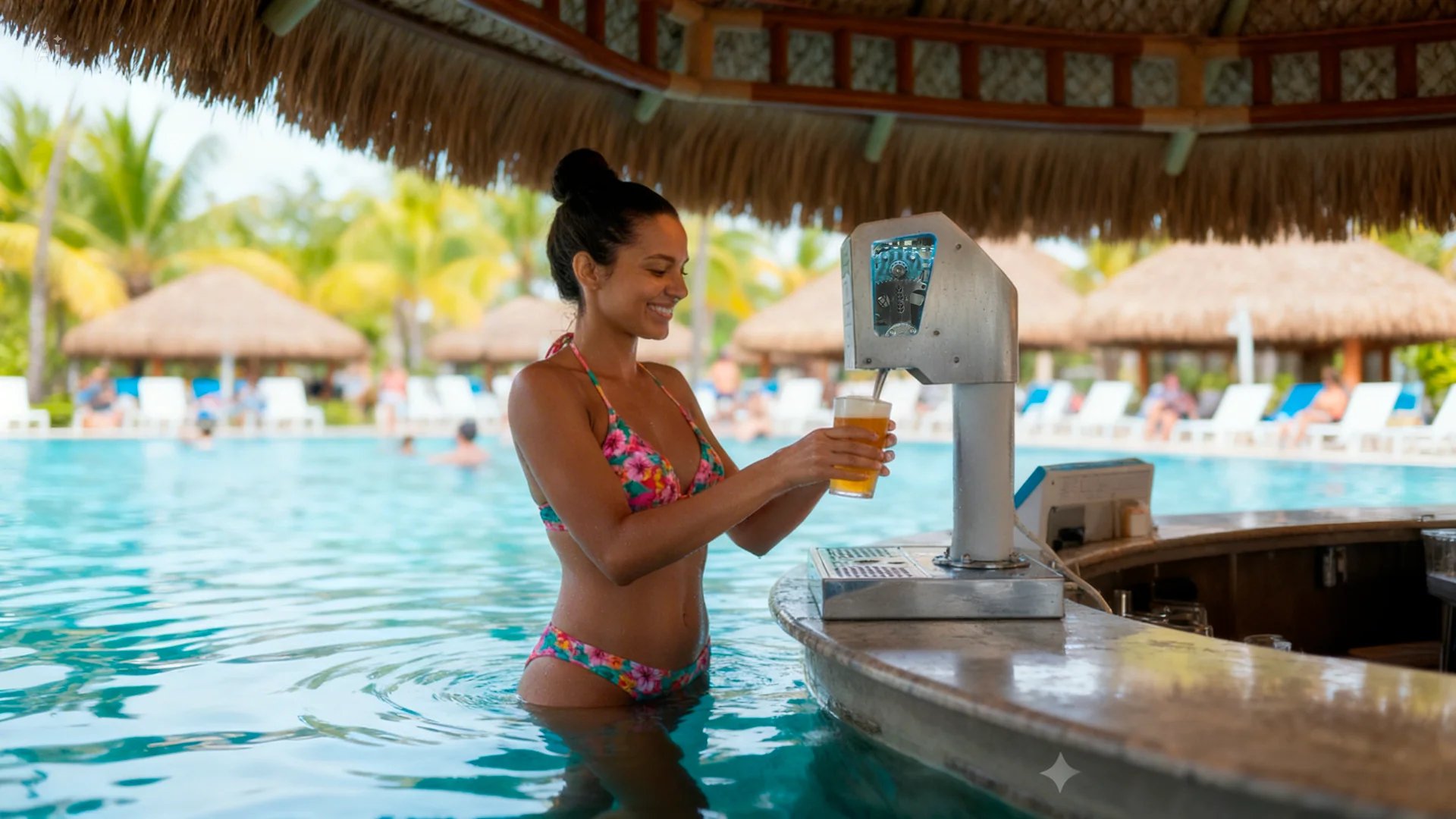
How to end lines and beverage waste at theme parks and resorts?
On the busiest day of the season, the bar at a park or resort lives a paradox. It is the moment when the most people want to buy, and at the same time the moment when the operation is least able to sell. The sun is strong, the pool is packed, and in front of the drinks counter forms the kind of line nobody wants to face in flip-flops with a towel in hand.
Anyone who runs this kind of business knows the scene. The visitor paid a lot for the day, wants to relax, but to get a draft beer has to leave the attraction, dry off, face the bar line and sometimes the top-up booth line too. Many simply give up and go back to the water. Each of those give-ups is a sale that did not happen, and they pile up precisely during the busiest hours.
The catch is that this problem is not solved by putting more people behind the counter. It is worth understanding why.
Why the bar line limits revenue in high season
A bar's selling capacity is defined by how many people it can serve in an hour. And that number has a ceiling: each attendant takes a fixed amount of time to take the order, pour the beer and hand it over. No matter how long the line gets, the counter cannot serve faster than that pace allows.
At peak, demand goes far above that ceiling. What is left over becomes lines, waiting and lost sales, not because too few people want to buy, but because the operation cannot keep up. And the obvious way out, scaling up the number of attendants, runs into two obstacles. First, cost: labor is expensive and, in high season, becomes scarce exactly when everyone needs it. Second, space: a Wet Bar in the middle of a water park cannot fit a battalion of people behind the counter.
So the operator is stuck in the same dilemma as large events. Small team, sales are lost in the line. Large team, the cost eats away the margin. Traditional beverage operations have no good answer for this, because they depend on one person for each service point.
What changes when visitors pour for themselves
The solution is not serving faster. It is letting the visitors serve themselves.
Self-pour beer flips the logic of the bar. Instead of waiting to be served, people go to the tap, tap the wristband they already use in the park and pour on the spot. The tap gains intelligence: a screen controls the release, measures every milliliter and automatically debits the cashless balance. No tokens, no double waiting, no dependence on anyone's speed.
This solves the peak bottleneck in a way that scaling up staff never could. Each tap becomes an independent point of sale. By multiplying the taps, the park serves many more people per minute without multiplying personnel. The line disappears and sales keep pace with the visitor's thirst instead of stalling on it.
And labor costs fall along with it. Since customers do the service themselves, a single person can support several taps, handling keg changes and guidance. The beverage service team can shrink by up to 80% compared with the one-attendant-per-point model. In a business where the high-season payroll weighs so heavily, this is a direct result on margin.
The proof is in the glass
There is a simple way to recognize a self-pour system that really works: look at the glass. When every pour comes out the same, at the right measure, with the foam head in the right proportion, it is a sign that the technology is controlling the service with precision.
That standardized glass is not just a matter of appearance. It is evidence that waste is under control. With beer poured by eye, the variation is huge: too much foam in one pour, a half-empty glass in the next, overflow in the following one. All this loss accumulates in the keg and usually runs around 15% of the volume. When the system measures and releases every milliliter, waste drops to close to 3%, up to five times less. In a high-turnover operation like a park's, that difference is money that stops going down the drain.
The data that decides the operation
The line is the visible problem. The lack of information is the silent one.
In manual operations, the manager only knows how much was sold when the register is closed. They find out too late that one brand ran out at the height of the heat or that another was left over. The day's decisions are made blind.
With self-pour, every milliliter served becomes real-time information. You can track consumption by tap, by point of sale and by hour while the park is operating, which lets you move kegs before they run out and reinforce the busiest points. That same history, accumulated over the season, becomes the basis for planning purchases, positioning bars and sizing the operation for the next peaks with precision, not guesswork.
Self-pour and cashless do not compete, they complement each other
It is worth clearing up a common confusion. Many parks and resorts already use a cashless wristband, and that does not compete with self-pour, quite the opposite.
Cashless solves how to pay: visitors move around without cash and top up their balance. But it does not solve the bottleneck of serving the drink; the bar line still exists. Self-pour fills exactly that gap, using the same wristband the park already hands out. One takes care of payment, the other takes care of service. Together, they cover the entire consumption journey, from entry to the last draft beer of the day.
From theory to practice
When these elements add up, shorter lines, smaller teams, less waste and more data, the bar stops being the park's choke point and starts pulling revenue up, without inflating the cost of the operation during the season.
Making this work in a high-volume, large-crowd environment requires equipment built for that pace. That is the focus of myTapp FAST, the self-pour line that myTapp designed for high-speed operations such as those of parks, resorts and large events. myTapp is a Brazilian beertech that has built these systems since 2015 and already counts more than 6,000 taps installed in more than 660 businesses, in Brazil and in more than 10 countries.
If your park or resort wants to end the bar line, reduce staff in high season and see every drink consumed, meet the myTapp solution for Parks and Resorts and build a draft beer operation tailored to your audience.
Frequently asked questions
How does self-pour beer reduce lines at parks and resorts?
Each tap becomes a point of sale where the visitor pours for themselves. With several taps in parallel, the park serves many more people per minute without depending on attendants' speed, which eliminates the peak bottleneck.
Does self-pour work with the cashless wristband my park already uses?
In most cases, yes. The systems integrate with the existing cashless setup and use the same wristband or card the visitor already receives at the entrance.
How much does self-pour reduce staffing?
The beverage service team can drop by up to 80%, because one person now supports several taps instead of pouring beer customer by customer.
How much waste does self-pour eliminate?
Draft beer waste usually falls from about 15% with manual service to close to 3% with volume control, a reduction of up to five times.
Does it work for all-inclusive resorts?
Yes. At resorts, self-pour can be linked to the guest's package, controlling what is included in the plan and recording all consumption by room or wristband.
Subscribe
Subscribe to the myTapp newsletter and get first access to new articles, with actionable insights for those who decide, plan, and run high-traffic businesses.
Recommended posts
Selected content to explore topics such as self-pour beer, customer experience, and operational efficiency, with practical lessons for decision-makers and those who follow market developments.
Capital Moto Week case study: how self-pour beer scaled the operation at a festival of 800,000 people
At the largest motorcycle and rock festival in Latin America, with about 800,000 people over ten days, self-pour beer kept pace with the event's growth without losing control. In the 2026 edition, the volume served rose more than 18% and the number of sales grew almost 29%, while operational efficiency went from 89% to 93%. The case shows how smart taps sustain beverage operations when the crowd arrives in waves.

Self-pour beer at parks and resorts: how to end lines and waste
In high season, the bar line is one of the biggest bottlenecks at a park or resort: visitors give up, miss out on the attractions and the operation loses sales. Self-pour beer ends the wait, cuts beverage service staff by up to 80% and reduces waste from about 15% to 3%, with real-time consumption data for management.
Self-pour draft beer for events: how to end the lines and sell more at festivals
At a festival's peak, the bar line is where revenue slips away. Self-pour draft beer ends the wait, cuts service staff by up to 80% and reduces waste from about 15% to 3%. With real-time consumption data, the operation decides on the spot and sells more at the moment that matters most.

Receive regular updates on new products and industry trends.