
Self-pour draft beer for events: how to end the lines and sell more at festivals
Self-pour draft beer for events: how to end the lines and sell more at festivals
At the peak hour of a festival, the bar decides a good part of the operation's financial result. That is where, when everyone wants to drink at the same time, the money comes in or slips away. And at most events, it slips away.
The scene is familiar to any producer. The main act starts, thirst kicks in, and a line forms. Except it is not one line, it is two: the cashier's, to buy the token, and the counter's, to pick up the cup. The crowd that came to spend ends up standing still, looking at the stage from afar, waiting for a beer that takes too long. Some give up. And whoever gives up at the peak rarely comes back later.
This is the paradox of the event bar: the moment of highest demand, which should be the moment of highest sales, tends to be the moment of greatest loss. It is worth understanding why this happens and what really solves the problem.
Why the line at peak time costs so much
The math is simpler than it looks. A bar's revenue in one hour is limited by how many people it can serve in that hour. If each attendant takes a fixed amount of time to take payment, pour the beer and hand it over, there is a ceiling of cups per hour, and that ceiling does not rise just because the line is huge.
At the peak, demand goes far above that ceiling. The result is lines, waiting and sales that simply do not happen, not because there is a lack of people wanting to buy, but because the operation cannot process them. Add to that the cost of trying to solve it by brute force: more attendants, more cashiers, more people to train and coordinate. Skilled labor is expensive and becomes scarce precisely in the high season for events, when everyone needs it at the same time.
So the organizer is squeezed between two expensive problems. Staff too few, and you lose sales in the line. Staff too many, and operating cost eats the margin. The traditional beverage operation has no good way out of this impasse, because it depends on one person for each service point.
What changes when the crowd serves itself
The way out of this impasse is not to speed up the server. It is to get the server out of the way.
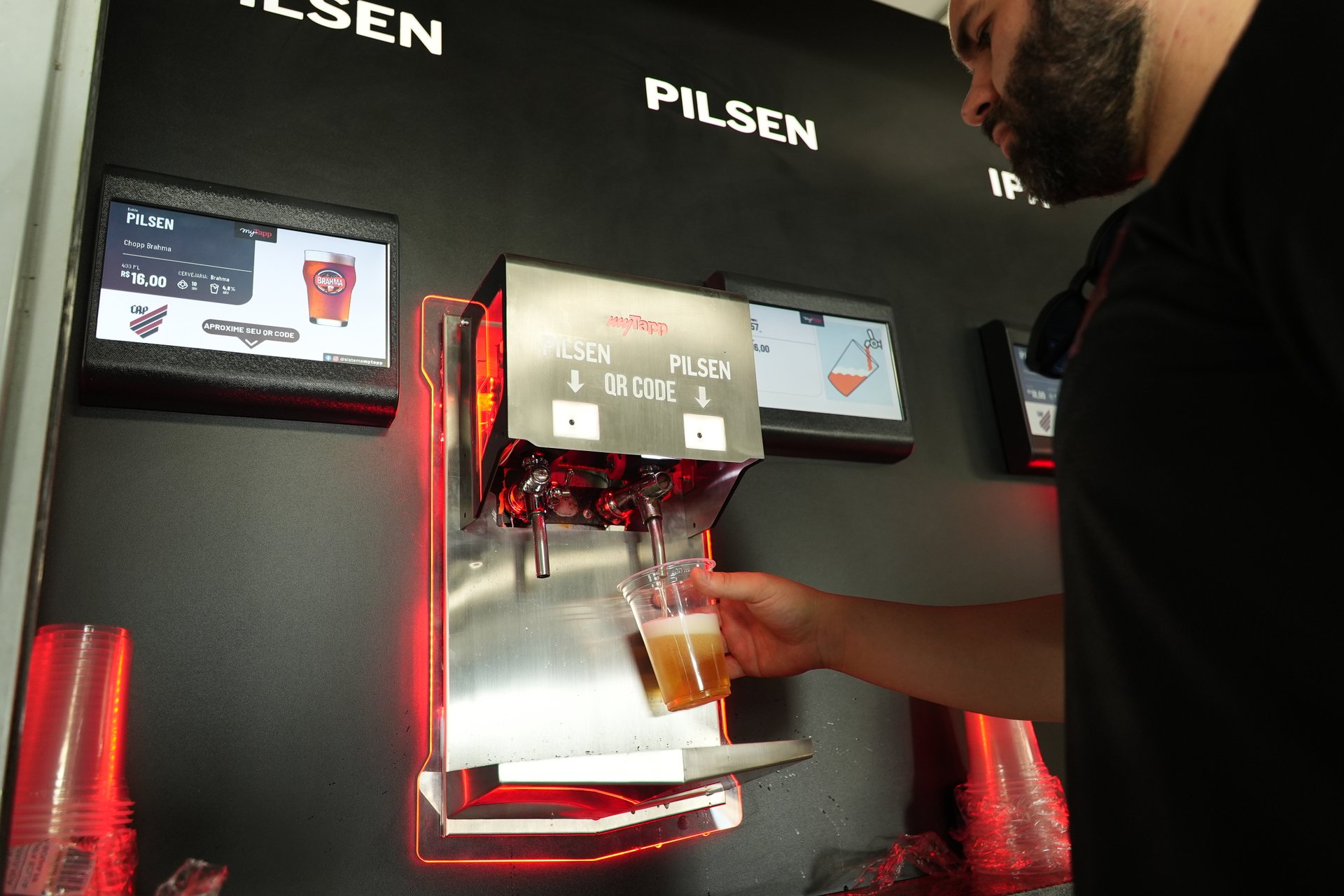
Self-pour draft beer flips the bar's logic. Instead of the crowd waiting to be served, they pour for themselves, straight from the tap. The beer still comes from refrigerated kegs, but the tap gains intelligence: a screen controls the release, measures every milliliter and charges on the spot, by card or by the cashless wristband the event already uses. People tap the card, pull the lever and walk away served in seconds.
This detail changes everything in the peak-hour math. Each tap becomes an independent point of sale that does not depend on anyone's speed to operate. By multiplying the taps, the event serves many more people per minute without multiplying the staff. The ceiling of cups per hour goes up, the line disappears and sales keep pace with the crowd's thirst instead of stalling on it.
And the personnel cost drops along with it. Since customers serve themselves, a single person can support several taps at once, handling keg changes and guidance. In practice, the service team can shrink by up to 80% compared to the one-attendant-per-point model. The counter stays lean, and the operation scales through technology, not through payroll.
The proof is in the cup
There is a simple way to tell whether a self-pour system really works: look at the cup. When every pour comes out standardized, at the right measure, with the right proportion of head, it is a sign that the technology is controlling the service precisely.
This "perfect cup" is not just aesthetics. It is visible proof that waste is under control. In manual service, draft beer poured by eye varies a lot: sometimes too much foam, sometimes a half-empty cup, sometimes overflowing. All that variation becomes loss in the keg, and that loss tends to hover around 15% of the volume. When the system measures and releases every milliliter, waste falls to close to 3%, up to five times less. At an event that sells thousands of liters, that difference shows up directly in the result.
The data nobody sees, but that decides the event
The line is the visible problem. The lack of data is the silent one, and perhaps the most expensive in the long run.
In a manual operation, the organizer only knows how much was sold when the register is closed at the end of the night. By then it is too late to act: one brand's keg ran out in the middle of the show, another was left over, and no one noticed in time. The event's decisions are made in the dark.
With self-pour, every milliliter served becomes real-time information. You can see consumption by tap, by point of sale and by time of day while the event is happening, which lets you move kegs before they run out and reinforce the points that are turning over the most. For those who organize recurring editions, that history stops being a guess and becomes the concrete basis for planning the next event: how much to buy, where to place the bars, how many taps to open.
Each role in the operation wins in a different way
An event brings together people with different goals, and the change at the bar speaks to all of them.
The producer wants the event to pay for itself and renew. They win on both sides of the equation: more revenue at the peak and lower operating costs, which directly improves the edition's viability.
The agency wants margin and something new to deliver to the client. Self-pour becomes a differentiator that is also Instagrammable, because pouring your own draft beer is a moment the crowd films and shares, generating long-tail buzz for the event's brand.
The beer channels and major beer brands want a premium experience and good exposure. They get a memorable activation, well presented, with the cup always up to brand standard.
And the bar operator wants fewer headaches. They get a lean operation, with one person covering several taps and far less staff logistics to manage.
How to size the bar for your crowd
Before setting up the operation, it is worth doing a flow calculation based on the peak, not the daily average. A festival expecting 5,000 people on a hot night needs far more simultaneous taps than the average traffic suggests. Three numbers guide this calculation: peak crowd per hour, number of points of sale and expected average consumption per person.
Since each self-pour tap yields more, by not depending on an attendant's speed, you can cover the same crowd with a leaner counter. And following the data during the event helps adjust the operation in real time, avoiding both the line and stockouts at the critical moment.
From theory to practice
When these elements come together, fewer lines, less staff, less waste and more data, the bar stops being the event's bottleneck and becomes a revenue lever. It is this combination that makes partners who adopted the model record up to 45% more in sales.
Putting this in place requires equipment designed to handle large crowds and high speed. That is the focus of myTapp FAST, the self-pour line that myTapp designed precisely for the peak scenarios and lean operation of events. myTapp is a Brazilian beertech that has manufactured these systems since 2015 and already totals more than 6 thousand installed taps across more than 660 businesses, in Brazil and in more than 10 countries.
If you organize events and want to end the bar line, reduce staff and sell more at the hour that matters most, discover the myTapp solution for Events and Festivals and build a draft beer operation tailored to your crowd.
Frequently asked questions
How does self-pour draft beer end lines at events?
Each tap works as an independent point of sale, where the crowd pours for themselves. With several taps in parallel, the event serves many more people per minute without depending on the speed of attendants, which eliminates the peak bottleneck.
Does self-pour draft beer completely eliminate the need for staff?
No, but it reduces it a lot. Since the customer serves themselves, one person can support several taps, which cuts service staff by up to 80% compared to the model with one attendant per point.
How much draft beer do you save with self-pour?
Waste drops from about 15% in the traditional operation to close to 3%, up to five times less, because the system measures and releases every milliliter and always delivers a standardized cup.
How does the crowd pay?
On the tap's own screen, unlocking the drink with a card or with the event's cashless wristband. Pre-loaded top-ups speed up sales even more, because the crowd arrives with credit and buys from the moment the gates open.
Can I know how much I sold during the event, not just at the end?
Yes. Consumption appears in real time by tap and point of sale, with POS and ERP integration, which lets you move kegs and reinforce points during the event.
Subscribe
Subscribe to the myTapp newsletter and get first access to new articles, with actionable insights for those who decide, plan, and run high-traffic businesses.
Recommended posts
Selected content to explore topics such as self-pour beer, customer experience, and operational efficiency, with practical lessons for decision-makers and those who follow market developments.
Capital Moto Week case study: how self-pour beer scaled the operation at a festival of 800,000 people
At the largest motorcycle and rock festival in Latin America, with about 800,000 people over ten days, self-pour beer kept pace with the event's growth without losing control. In the 2026 edition, the volume served rose more than 18% and the number of sales grew almost 29%, while operational efficiency went from 89% to 93%. The case shows how smart taps sustain beverage operations when the crowd arrives in waves.

Self-pour beer at parks and resorts: how to end lines and waste
In high season, the bar line is one of the biggest bottlenecks at a park or resort: visitors give up, miss out on the attractions and the operation loses sales. Self-pour beer ends the wait, cuts beverage service staff by up to 80% and reduces waste from about 15% to 3%, with real-time consumption data for management.
Self-pour draft beer for events: how to end the lines and sell more at festivals
At a festival's peak, the bar line is where revenue slips away. Self-pour draft beer ends the wait, cuts service staff by up to 80% and reduces waste from about 15% to 3%. With real-time consumption data, the operation decides on the spot and sells more at the moment that matters most.

Receive regular updates on new products and industry trends.