
Electric draft beer dispenser, cold room, kegerator or refrigerated counter?

Despite the popularity of bottled beer, the market's biggest success comes from beers served straight from the keg: draft beer. That raises the question of which cooling system is best for selling the famous draft beer in your business: an electric draft beer dispenser or a cold room?
There is no absolute answer, because every establishment is unique and operates under different conditions. But we are here to tell you more about each one and share a few secrets that can help you choose! Shall we?
Electric draft beer dispenser
Electric draft beer dispensers are sold in different models, and the flow rate varies according to the temperature of the beer used, which can be at room temperature or chilled to the minimum temperature, down to 12 degrees (Celsius), so there is no risk of freezing.
In the first case, the flow rate ranges from 30 to 110 liters per hour. If the beer is already chilled, this capacity increases, going to 50 to 200 liters per hour. All models are equipped with direct expansion, which allows the beer to be dispensed 5 minutes after the dispenser is turned on. The beverage can be consumed at a temperature of 0 to 1 degree.
It is made up of the valve, pressure regulator, keg, CO2 cylinder for pressurization and the dispenser itself, which sits on top and from which the beverage is served. Those with lower flow rates are available in 127V or 220V, and those that allow higher flow are available only in 220V.
It is important that the dispenser be positioned at least four meters from any heat source, such as an oven or grill. To turn it on, it needs to be near an outlet and a water source, such as a sink, so that glasses and coils can be washed.
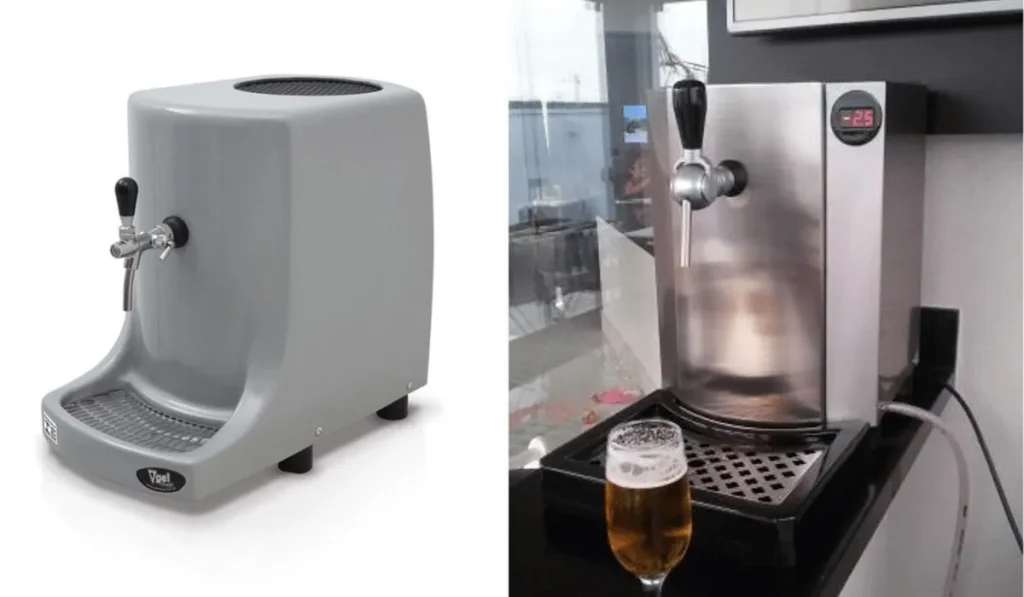
Examples of dispenser models (Gel Shop and Chopeiras Beer Coolers)
Types of draft beer dispensers: find out which is best for you
Cold room
A beer cold room makes it possible to store a large quantity of beer, draft beer and other fermented beverages for a long period of time. It offers ideal temperature conditions, thanks to the ability to adjust the temperature as needed.
A cold room has no minimum or maximum size and can be custom built to the needs of the establishment. Usually, the finish is pre-painted steel and it has an insulating core that can be made of either EPS (polystyrene) or PUR (polyurethane). The insulating core ensures the ideal temperature is held and does not let heat in.
With a cold room, you can store a large number of draft beer kegs and other drinks, such as sparkling wine, whisky and wine, for example. This is possible because you have the recommended temperature conditions for storing beverages, since adjusting the temperature is possible, easy and fast.
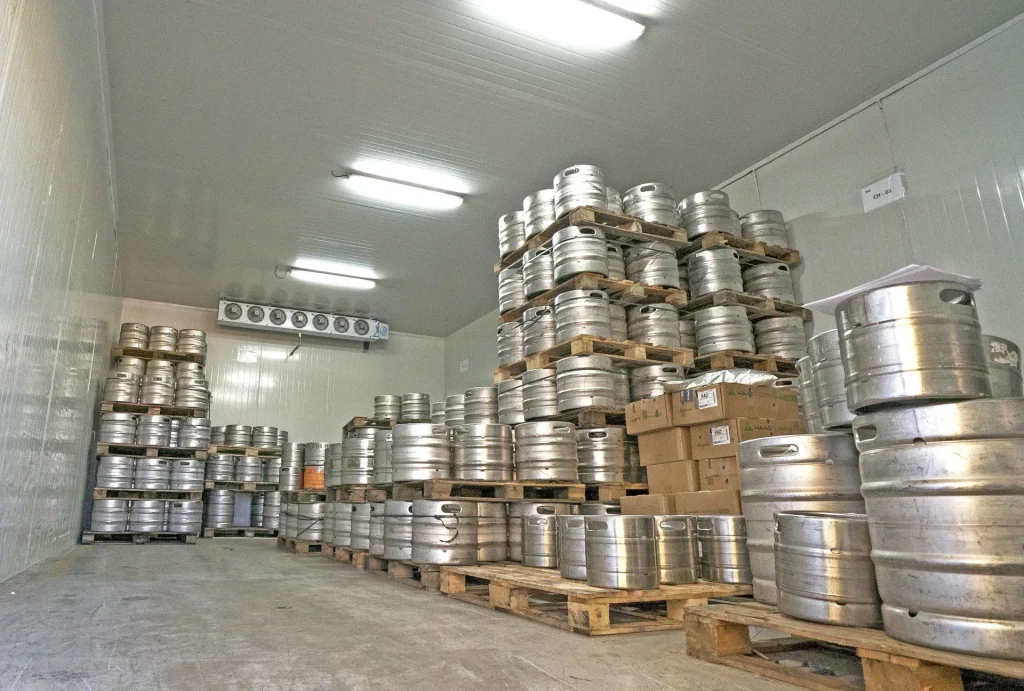
Example of a cold room at Cervejaria Colorado, a myTapp client, built by MultiFrio
Refrigerated counter
The refrigerated counter is commercial equipment often used in bakeries, markets and meat-packing plants. Its size is variable, like that of the cold room, because it can be custom built to the needs of the environment. It is recommended to store draft beer between 0 and 8 °C, also taking into account variations according to the product.
Usually, the finish is brushed stainless steel and the components are: compressor, condenser, pressure-relief valve and evaporator.
This model provides cooling similar to that of a cold room. However, not all refrigerated counter models have the capacity to store beverage stock. Therefore, a cooling period is needed between keg changes.
However, stock problems can be solved by installing a pre-chiller and having an extra cold room or refrigerated counter for storing spare kegs.
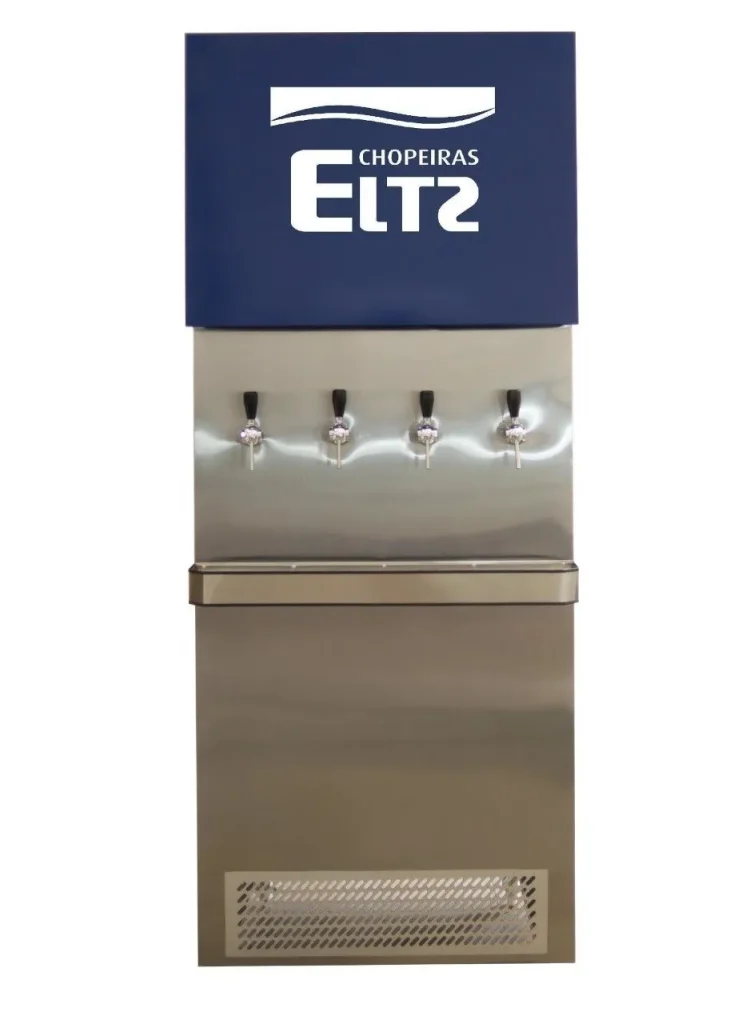
Example of a refrigerated counter made by Chopeiras Eltz
Kegerator
This is a cooling setup that is generally built by hand, but it can also be found in commercial versions already available on the market. Its name comes from combining the English words: keg + refrigerator.
It is made up of a refrigerator, which stores the keg, and components that dispense the draft beer.
Some kegerators have space inside the refrigerator to store backups of your most popular kegs, so you can swap them quickly and easily when needed, although this space is quite limited.
Its biggest appeal is cost-effectiveness, but the number of taps is limited by the size of the refrigerator and the size of the kegs chosen, generally between 1 and 3. Compared with the other alternatives, its look is less attractive.
So, electric draft beer dispenser or cold room?
Now you know a little more about each one, right? So let's make some comparisons on a few points that matter for your decision:
Layout
To boost sales, the layout of the space should highlight the product. As the popular saying goes, "consumers buy first with their eyes."
So customizable systems, such as the refrigerated counter and the cold room, better meet aesthetic requirements.
And for establishments with a self-pour draft beer system it is even better: the layout will make it easier for customers to reach the taps, sparking the desire to try the different types of draft beer available!
Mobility
The electric draft beer dispenser is not the lightest thing in the world, but it can be carried to different places simply and quickly. This attribute appeals to many breweries and bars that are always on the move and do a lot of events.
Cooling
This is a very important point. The electric draft beer dispenser has a coil, which helps cool the beer. However, the keg must be chilled beforehand so there is no risk of getting excess foam when it's time to drink.
So the other cooling models are more advantageous. With the kegs stored in a place that already provides cooling, the beer will be ready to drink at any time, without warming up even an inch of line that sits in the tap.
Here the cold room is doubly advantageous, because it cools the kegs in stock, making it easier to change kegs while the bar is operating.
Cost
You might think, at first glance, that a cold room is much more expensive than the other cooling models. In theory, you're right!
But the ideal is always to analyze the number of taps you want to run and, consequently, to profit from draft beer sales. The cold room and the refrigerated counter allow for drilling countless taps, while the electric dispenser and the kegerator have a more limited number of taps (usually you work with 1 or 2), and you need to buy more equipment if you want to increase the number of taps.
Cleaning
Here's something you can't forget: cleaning your equipment.
There are no glaring differences on this point, but during the process, the amount of beer left in the coil will be wasted.
On this point, the best options are the models that do not use coils, such as the cold room, refrigerated counter and kegerator, which use 100% of the beer in the keg.
All the cooling system options for selling draft beer have their pros and cons, and it's up to you to understand which fits your business model best.
myTapp always recommends using cold rooms to bring your customer the best that draft beer has to offer. Cold beer, straight from the source! The only way to make it better is with self-pour, right? How about talking with us?
So, shall we talk so you can learn more about myTapp and self-pour draft beer?
Subscribe
Subscribe to the myTapp newsletter and get first access to new articles, with actionable insights for those who decide, plan, and run high-traffic businesses.
Recommended posts
Selected content to explore topics such as self-pour beer, customer experience, and operational efficiency, with practical lessons for decision-makers and those who follow market developments.
Capital Moto Week case study: how self-pour beer scaled the operation at a festival of 800,000 people
At the largest motorcycle and rock festival in Latin America, with about 800,000 people over ten days, self-pour beer kept pace with the event's growth without losing control. In the 2026 edition, the volume served rose more than 18% and the number of sales grew almost 29%, while operational efficiency went from 89% to 93%. The case shows how smart taps sustain beverage operations when the crowd arrives in waves.

Self-pour beer at parks and resorts: how to end lines and waste
In high season, the bar line is one of the biggest bottlenecks at a park or resort: visitors give up, miss out on the attractions and the operation loses sales. Self-pour beer ends the wait, cuts beverage service staff by up to 80% and reduces waste from about 15% to 3%, with real-time consumption data for management.
Self-pour draft beer for events: how to end the lines and sell more at festivals
At a festival's peak, the bar line is where revenue slips away. Self-pour draft beer ends the wait, cuts service staff by up to 80% and reduces waste from about 15% to 3%. With real-time consumption data, the operation decides on the spot and sells more at the moment that matters most.

Receive regular updates on new products and industry trends.