
Italian or Belgian draft beer tap: which one to choose?

For anyone about to open a business that will serve keg draft beer, one question comes up: which is the best draft beer tap? Is the Italian or the Belgian draft beer tap better for my business and my customers?
Before choosing the ideal model for your venue, you need to understand how your business will run, your priorities and your sales model. And of course, learn a bit more about each draft beer dispenser tap.
What is the best type of tap?
Draft beer tap styles may look similar at first glance, but their differences can become a headache if they are not used to your advantage.
Think about this already in the planning stage of the big moment that is opening a bar, or any other business that serves draft beer. Here are the items you can't overlook; check out what they are:
Flow adjustment
One of the points that is most part of everyday life for anyone working with draft beer, and one of the main ones to consider when choosing the tap style, is flow.
In the comparison we will make here, we can see some differences that are worth keeping in mind when making your choice.
The Italian draft beer tap has an external flow regulator, which lets you control the flow at any time. This simplifies daily operations and allows adjustments to be made faster, more practically and more efficiently.
Belgian taps, on the other hand, have an internal controller and can be adjusted with an Allen key, depending on the beer style you want to serve. Although this feature is useful to prevent other people from changing the flow in everyday use, it is a bit slower and more complex if you serve different types of draft beer on the same tap on different days of the week.
As we can see, this is a point that depends 100% on how you want to run your bar. The flow of each tap depends on its recipe, and if you are always changing the style, it may be worth considering an Italian draft beer tap for its practicality.
However, if your brewery already has fixed labels and you want to change the flow very little, the Belgian may be a good tap style for you.
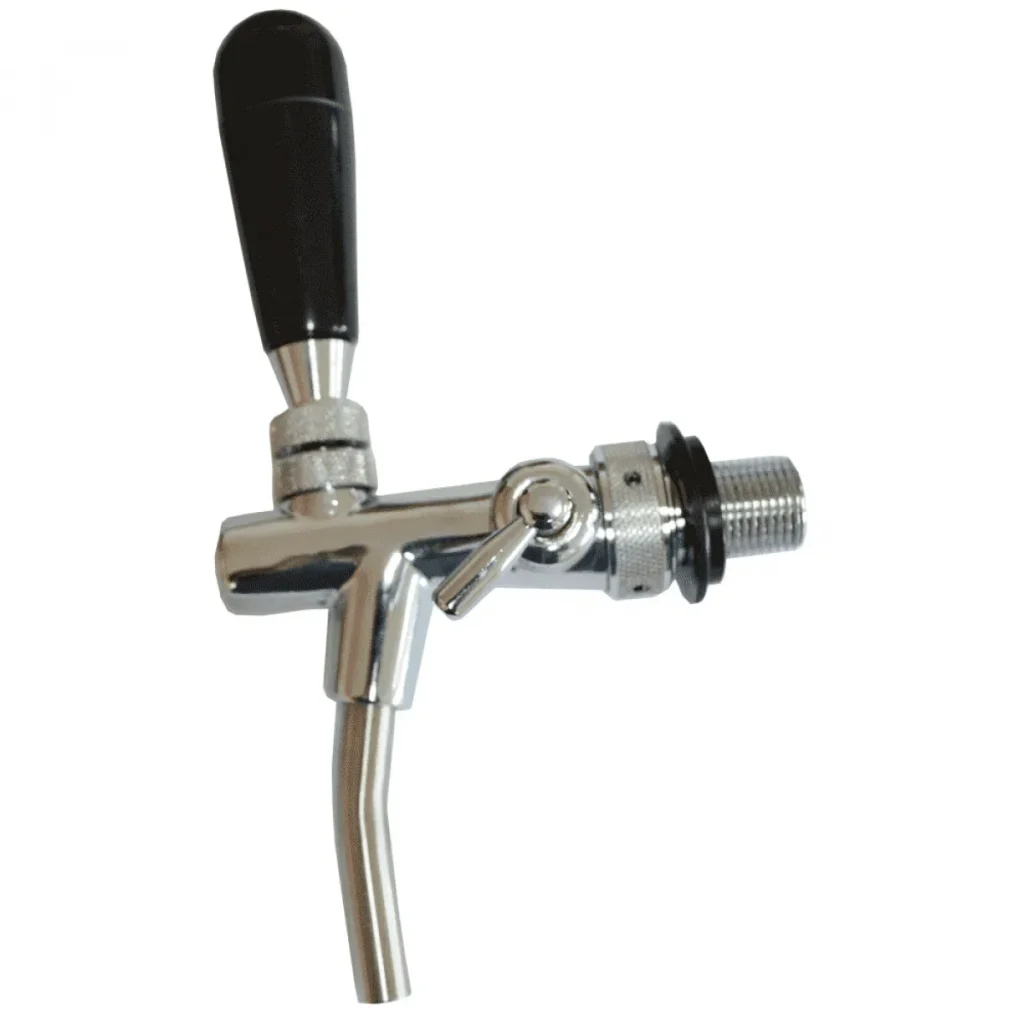
Italian tap
[e-book] Self-pour vs. the traditional model
Usability
With a spring or without? That is, in simple terms, the difference in the levers of the two types.
While the Belgian-style tap requires more technical knowledge about pouring draft beer, the Italian tap is ideal for handling by all kinds of users.
The Italian tap works with no mystery: pulling the lever forward pours the draft beer, and tilting it slightly back creams the head. In addition, the tap returns to its neutral state automatically. That is, when you finish pouring, you just let go of the tap and it returns to the initial position, shutting off the flow.
The Belgian tap, on the other hand, works with a 90º range of motion and its function changes depending on how far it is opened. To pour the draft beer, lower the lever completely, and to cream the head, the lever must be in an intermediate position, that is, at 45º.
Comparing the two styles, usability belongs entirely to the Italian draft beer tap. Simpler and more practical to use for all audiences and without the need for extensive staff training, for example.

Belgian tap
Price
This is a super important factor and one that really differentiates these two types of draft beer tap for many businesses, especially tap houses, bars and breweries that will serve many types of beer.
The Italian draft beer tap is easier to find in Brazil and the approximate investment in each is around R$ 200,00. The Belgian tap, meanwhile, is found – on average – for R$ 300,00, reaching up to R$ 400,00 in some regions.
With a difference that can be 100%, the Italian tap stands out on this point, bringing more savings to anyone starting a bar or making changes to one.
The Italian draft beer tap comes out ahead
Of course this is not an absolute truth and the choice will depend on the venue's priorities. For someone with a team of servers and who only occasionally changes the styles on each tap, for example, the Belgian can be a good bet.
However, for businesses that constantly rotate styles or want to offer self-pour draft beer, myTapp recommends the Italian taps. They prevent draft beer waste and headaches, since customers can feel shortchanged by lost beer and irritated by not being able to pour properly.
So, the golden tip here is: know your sales model well and, of course, if you are considering self-pour draft beer, don't forget to request our contact. I'm sure the conversation will be great!
So, shall we chat so you can learn more about myTapp and self-pour draft beer?
Subscribe
Subscribe to the myTapp newsletter and get first access to new articles, with actionable insights for those who decide, plan, and run high-traffic businesses.
Recommended posts
Selected content to explore topics such as self-pour beer, customer experience, and operational efficiency, with practical lessons for decision-makers and those who follow market developments.
Capital Moto Week case study: how self-pour beer scaled the operation at a festival of 800,000 people
At the largest motorcycle and rock festival in Latin America, with about 800,000 people over ten days, self-pour beer kept pace with the event's growth without losing control. In the 2026 edition, the volume served rose more than 18% and the number of sales grew almost 29%, while operational efficiency went from 89% to 93%. The case shows how smart taps sustain beverage operations when the crowd arrives in waves.

Self-pour beer at parks and resorts: how to end lines and waste
In high season, the bar line is one of the biggest bottlenecks at a park or resort: visitors give up, miss out on the attractions and the operation loses sales. Self-pour beer ends the wait, cuts beverage service staff by up to 80% and reduces waste from about 15% to 3%, with real-time consumption data for management.
Self-pour draft beer for events: how to end the lines and sell more at festivals
At a festival's peak, the bar line is where revenue slips away. Self-pour draft beer ends the wait, cuts service staff by up to 80% and reduces waste from about 15% to 3%. With real-time consumption data, the operation decides on the spot and sells more at the moment that matters most.

Receive regular updates on new products and industry trends.