
How bars can earn more during the World Cup with automation
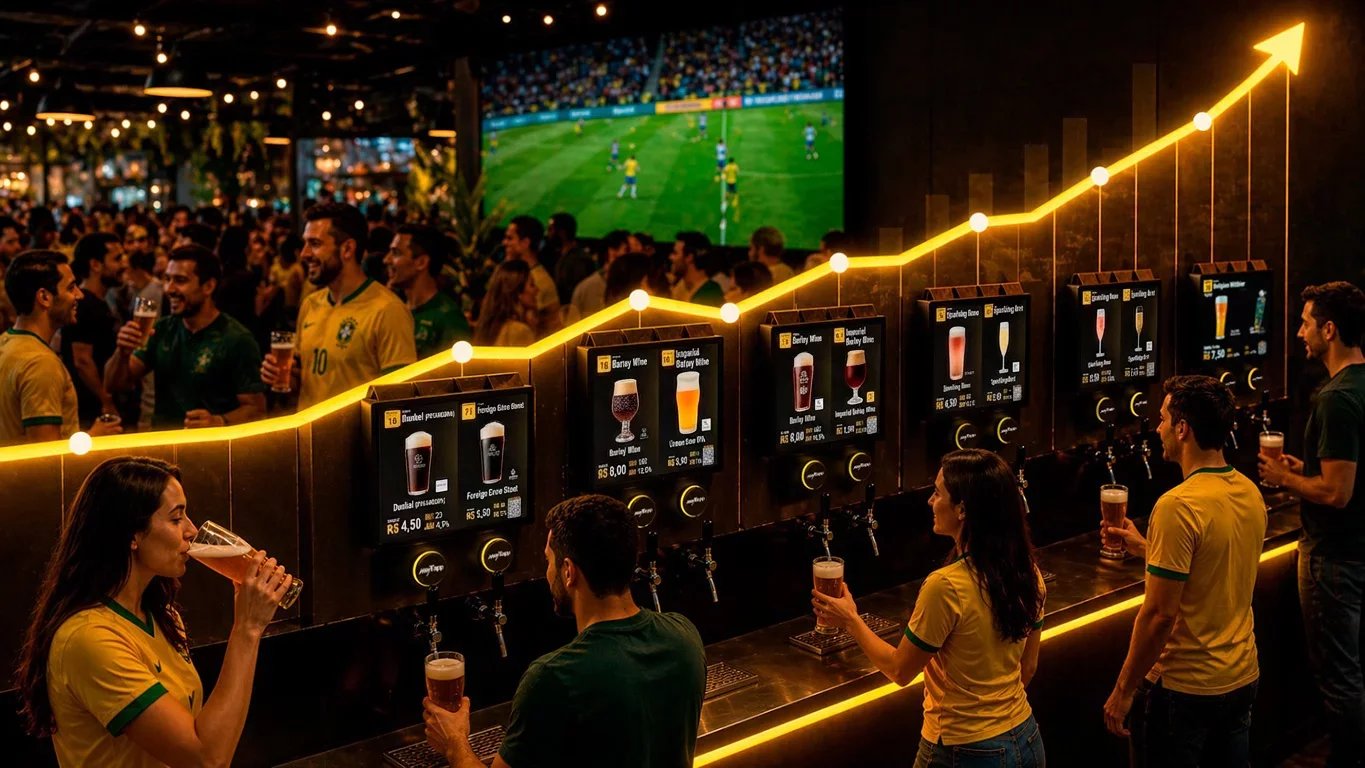
During the World Cup, bars operate under some of the heaviest demand pressure of the calendar. In just a few hours, order volume can multiply, demanding speed, control and a line-free experience. With automation, you can reduce bottlenecks, increase turnover per service and capture more revenue in every match.
Why is the World Cup a unique opportunity for bars?
The World Cup concentrates, in just a few days, consumption behavior comparable to the biggest events of the year. Decisive matches raise traffic, increase the average ticket and extend how long customers stay. For bars, this means greater revenue potential per square meter and per hour of operation.
This growth, however, depends directly on operational capacity. When the setup doesn't keep up with demand, lines form, orders are lost and the customer experience deteriorates. At events with heavy concentration, every minute of waiting can mean lost sales.
What are the main bottlenecks during high-demand matches?
The most common challenges on busy days include:
- Long lines at the counter and the register
- Long time between order and delivery
- Staff tied up in repetitive operational tasks
- Lost sales from customers giving up
- Difficulty controlling inventory and waste in real time
In traditional operations, peak demand tends to overload exactly the most critical points: payment, pickup and drink service.
How does automation increase service capacity?
Automation redistributes the operational flow. Instead of relying exclusively on manual service, the bar starts operating with faster, more predictable and more scalable processes.
Main operational gains
- Shorter service time per order
- Fewer lines at peak hours
- Staff redirected to higher-value activities
- Greater accuracy in consumption and inventory control
- Standardized service, even at high demand
Solutions such as self-service, digital payment, QR Code top-ups and automated taps eliminate manual steps that limit the speed of the operation.
Where is the financial gain?
The financial impact of automation shows up on three main fronts:
Indicator | Traditional operation | Automated operation |
|---|---|---|
Average service time | High | Reduced |
Capacity per hour | Limited by staff | Scalable |
Sales lost to lines | High | Lower |
Operating cost per service | Higher | Optimized |
Turnover per point of sale | Restricted | Expanded |
With greater speed, the bar serves more people in the same period. This increases turnover, improves use of staff and reduces operational losses.
Which technologies have the most impact during the World Cup?
1. Self-service drinks
Reduces lines, speeds up pickup and gives customers autonomy.
2. QR Code payment
Removes entry barriers, reduces dependence on physical cards and speeds up top-ups.
3. Automated taps for events
Enable fast, standardized service with less need for dedicated labor.
4. Integrated real-time management
Centralizes sales, consumption, inventory and operational indicators on a single platform.
How to prepare the operation before the first match?
- Map the biggest line points in the current operation
- Review service capacity per hour
- Define payment and pickup flows
- Automate critical high-volume steps
- Train the team for the new operating model
- Run tests before the official opening
Operational preparation is what turns demand into revenue.
Who benefits most from this model?
This model is especially suited to:
- Sports bars
- Operations with heavy draft beer consumption
- Venues with live events
- Establishments with concentrated demand peaks
- Businesses that want to scale without growing staff proportionally
Practical case: what do high-traffic operations already show?
In environments with large crowds, automation reduces bottlenecks at the points of greatest friction. Replacing manual processes with self-service and digital payment allows better distribution of staff, shorter lines and higher turnover per period.
In addition, eliminating repetitive tasks frees employees for sales and relationship activities, raising operational efficiency and the perceived quality of service.
FAQ: frequently asked questions about automation for bars during the World Cup
1. Does automation replace the team?
No. It redistributes roles, allowing the team to work on more strategic and sales-oriented activities.
2. Is it possible to implement it before the World Cup?
Yes. With proper planning, implementation can take place in just a few weeks, including training and testing.
3. Do customers accept self-service well?
Yes. When the experience is simple and fast, adoption tends to be high, especially at events.
4. Does the investment pay back quickly?
In high-traffic operations, the return tends to come from the combination of higher sales and lower operating costs.
5. Which areas should be automated first?
Prioritize the biggest bottlenecks: payment, drink pickup and consumption control.
Prepare your operation for the World Cup
The World Cup is a concentrated revenue opportunity. Bars that operate with speed, predictability and efficiency capture this demand better.
Automation is not just a technological upgrade. It is a practical strategy to sell more, serve better and operate with control during the busiest moments.
Prepare your operation for the World Cup and find out how to scale your service more efficiently.
Subscribe
Subscribe to the myTapp newsletter and get first access to new articles, with actionable insights for those who decide, plan, and run high-traffic businesses.
Recommended posts
Selected content to explore topics such as self-pour beer, customer experience, and operational efficiency, with practical lessons for decision-makers and those who follow market developments.
Capital Moto Week case study: how self-pour beer scaled the operation at a festival of 800,000 people
At the largest motorcycle and rock festival in Latin America, with about 800,000 people over ten days, self-pour beer kept pace with the event's growth without losing control. In the 2026 edition, the volume served rose more than 18% and the number of sales grew almost 29%, while operational efficiency went from 89% to 93%. The case shows how smart taps sustain beverage operations when the crowd arrives in waves.

Self-pour beer at parks and resorts: how to end lines and waste
In high season, the bar line is one of the biggest bottlenecks at a park or resort: visitors give up, miss out on the attractions and the operation loses sales. Self-pour beer ends the wait, cuts beverage service staff by up to 80% and reduces waste from about 15% to 3%, with real-time consumption data for management.
Self-pour draft beer for events: how to end the lines and sell more at festivals
At a festival's peak, the bar line is where revenue slips away. Self-pour draft beer ends the wait, cuts service staff by up to 80% and reduces waste from about 15% to 3%. With real-time consumption data, the operation decides on the spot and sells more at the moment that matters most.

Receive regular updates on new products and industry trends.