
How to expand points of sale with more speed and control
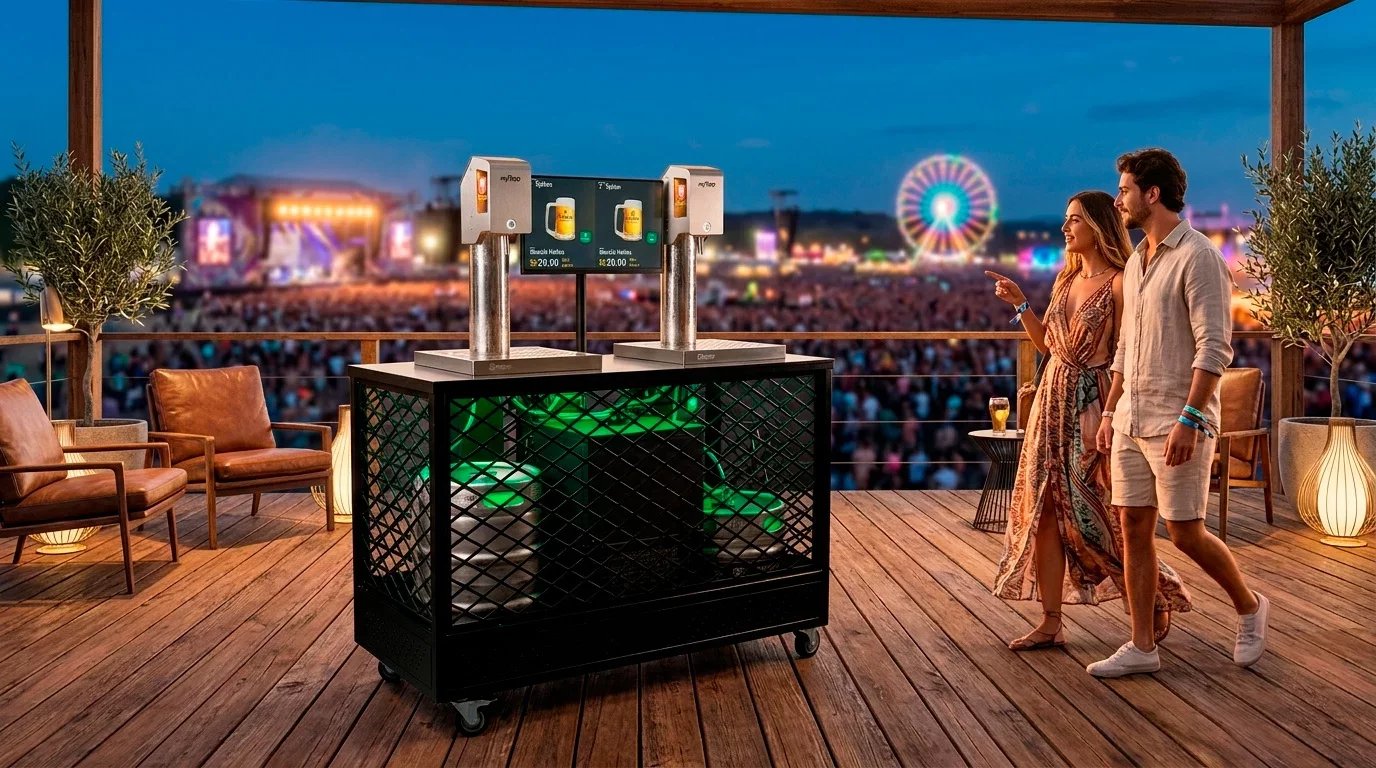
Expanding at events depends on cutting lines, speeding up service and keeping control in high-demand environments. Operations that use distributed, integrated systems can add points of sale without adding operational complexity. Solutions like myTapp Duo let you scale service with consistency, predictability and a direct impact on revenue per hour.
How does operational expansion work at events?
At events, expanding doesn't just mean opening more physical points. It means absorbing demand peaks with operational efficiency.
For Carlos, who manages events, this translates into a practical equation:
- More audience → higher simultaneous order volume
- More orders → higher risk of lines and walkaways
- More points of sale → greater control complexity
Efficient expansion happens when these three factors are coordinated with technology.
Who needs to optimize operational expansion?
This model serves operations with:
- Medium and large events (festivals, concerts, fairs)
- Concentrated consumption peaks in short periods
- Temporary or mobile sales structures
- Rotating teams with different levels of training
What are the real bottlenecks when expanding points of sale?
1. Lines as a revenue limiter
Every minute in line represents unfinished orders.
Practical impact:
- Longer average service time
- Abandoned purchases
- Lost turnover per hour
2. Lack of synchronization between points
When each point operates in isolation, you get:
- Inventory discrepancies
- Operational rework
- Difficulty closing the books
3. Low real-time visibility
Without centralized data, Carlos can't:
- Identify bottlenecks during the event
- Quickly redistribute staff
- Adjust the operation based on real demand
How to expand faster: a technical step-by-step
1. Map demand by zone and time
Before the event, you need to estimate:
- Consumption peaks (e.g., between sets at concerts)
- Highest-traffic zones
- Expected average ticket
Implication: it defines how many points of sale are needed.
2. Distribute points of sale strategically
Avoid excessive concentration at a single point.
Technical criterion:
- Reduce how far the audience has to travel
- Shorten local lines
- Increase service coverage
3. Reduce the service time per order
This is where the biggest scale gain is.
Practical example:
- Traditional operation: 90 seconds per order
- Optimized operation: 45 seconds per order
Result: the same point doubles its capacity without physical expansion.
4. Integrate orders and payments into a single flow
This is where myTapp Duocomes in.
Duo lets you:
- Separate ordering and pickup when needed
- Create multiple order entry points
- Sync data in real time across operations
Direct impact:
- Fewer visible lines
- Higher throughput (orders/hour)
- Greater operational predictability
5. Monitor the operation in real time
During the event, decisions need to be fast.
With centralized data, Carlos can:
- Identify overloaded points
- Reallocate staff
- Quickly open or close points
Real expansion scenarios
Scenario 1: Event with a high concentration of people
- Problem: lines longer than 15 minutes
- Solution: multiple points with decentralized ordering
- Expected result: lines cut to under 5 minutes
Scenario 2: Bigger audience without a bigger setup
- Problem: the operation can't keep up with demand
- Solution: shorter service time + integration with myTapp Duo
- Expected result: up to 2x more capacity per point
Scenario 3: Operation with multiple operators
- Problem: lack of financial and inventory control
- Solution: centralizing data in real time
- Expected result: faster closing and fewer inconsistencies
Indicators that show whether your expansion is working
Indicator | Before optimization | After integrated operation |
|---|---|---|
Average line time | 10–20 min | 3–8 min |
Orders per hour/point | 40–60 | 80–120 |
Abandonment rate | High | Reduced |
Operational control | Fragmented | Centralized |
Objective benefits of expanding with technology
- More revenue per hour without a proportional increase in infrastructure
- Fewer losses from people leaving the line
- Greater financial and operational control
- Ability to make decisions in real time
- Scalability with lower operational risk
FAQ
How do I know how many points of sale I need?
It depends on the expected volume and the average service time. The basic math is orders per hour vs. capacity per point.
Does expanding always mean opening more physical points?
No. Reducing service time can have the same effect as expansion.
What is the biggest mistake at events?
Underestimating lines and having no real-time visibility into the operation.
Does myTapp Duo replace traditional cashiers?
It can replace or complement them, creating a more distributed and efficient operation.
How do I measure whether the expansion worked?
Through indicators such as line time, orders per hour and abandonment rate.
How myTapp Duo makes this expansion possible
myTapp Duo acts as an operations orchestration layer:
- Connects multiple points of sale
- Centralizes data in real time
- Lets you scale service without adding complexity
- Reduces reliance on manual processes
For Carlos, this means turning growth into something controllable and predictable.
Request an expansion assessment
Every event has a different consumption pattern. An assessment lets you identify:
- Current bottlenecks
- Real service capacity
- Revenue growth opportunities
Subscribe
Subscribe to the myTapp newsletter and get first access to new articles, with actionable insights for those who decide, plan, and run high-traffic businesses.
Recommended posts
Selected content to explore topics such as self-pour beer, customer experience, and operational efficiency, with practical lessons for decision-makers and those who follow market developments.
Capital Moto Week case study: how self-pour beer scaled the operation at a festival of 800,000 people
At the largest motorcycle and rock festival in Latin America, with about 800,000 people over ten days, self-pour beer kept pace with the event's growth without losing control. In the 2026 edition, the volume served rose more than 18% and the number of sales grew almost 29%, while operational efficiency went from 89% to 93%. The case shows how smart taps sustain beverage operations when the crowd arrives in waves.

Self-pour beer at parks and resorts: how to end lines and waste
In high season, the bar line is one of the biggest bottlenecks at a park or resort: visitors give up, miss out on the attractions and the operation loses sales. Self-pour beer ends the wait, cuts beverage service staff by up to 80% and reduces waste from about 15% to 3%, with real-time consumption data for management.
Self-pour draft beer for events: how to end the lines and sell more at festivals
At a festival's peak, the bar line is where revenue slips away. Self-pour draft beer ends the wait, cuts service staff by up to 80% and reduces waste from about 15% to 3%. With real-time consumption data, the operation decides on the spot and sells more at the moment that matters most.

Receive regular updates on new products and industry trends.